記録 Archive
The founder of Aikido
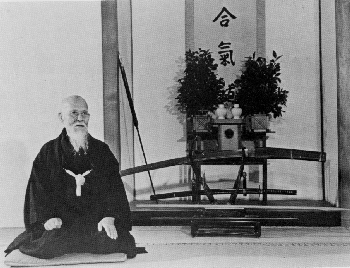
Morihei Ueshiba (1883 - 1969)
O-Sensei was a man who had devoted his whole life to the study of Martial Arts, and the perfection of himself as a human being. Born in 1883 in Tanabe, a small fishing village near Osaka, he grew up in an environment where the fighting arts were common place. Being of small stature and sometimes ill-health, his life of struggle, travel, failures and successes, and an apparent talent for Martial Arts, transformed him into a tenacious and hard working leader.
While in northern Hokkaido, helping establish a settlement town, he encountered a Daito-Ryu Aiki Ju-Jutsu teacher that was to have a profound effect on him. O-Sensei followed and studied with this fierce and eccentric nomad sporadically for a number of years, and began teaching the art himself, due to his fame that was spreading regarding his martial prowess.
O-Sensei was once known as the strongest man in Japan; he was challenged by and defeated the champion Sumo Tennryu, taught Martial Arts to Admirals of the Japanese Navy and demonstrated his techniques for the Emperor.
Although Aikido is a Martial Art, it also includes imagery, poetry and a deep philosophy of life based upon the principles of Shinto and Shingon, two small but popular religions in Japan that expound the need for an appreciation and harmony with the Universe, a respect for the natural world. He was also called the most religious man in Japan, as he would stop and pray at every shrine he walked past. In his earlier years, he underwent formal training at a Shingon Buddhist temple, and also spent a great deal of time studying Shinto of the Omoto sect under Onisaburo Deguchi, a charismatic though somewhat radical religious leader of the pre-war years.
O-Sensei, which means “great teacher”, devoted his whole life to the path of Budo, the Martial Way, and set an example to all people by treading the precarious path between Martial Arts and Spirituality. His belief was that Aikido is a means of transforming the body, mind and spirit to reach enlightenment by studying Martial Arts with the right intentions in mind.
Sometime during his mid-fifties, O-Sensei, experienced a revelation after he was challenged to a duel in which he defeated one of Japan’s top kendo masters. This experience led O-Sensei to change his view on the meaning of Martial Arts, and sometime in 1942 began calling his new art Aikido. He moved to the countryside outside Tokyo, not only to escape the US occupational forces which forbade Martial Arts after WWII, but also to concentrate more on farming, and to spend more time to developing his ideas on Aikido. Here, favoured students lived, worked and trained with O-Sensei, for the next 25 years. From this point, Aikido was born. One of these students, Morihiro Saito, was to stay with O-Sensei for the next 23 years, until his death.
During this time, O-Sensei travelled widely, teaching, lecturing, and giving public demonstrations. Many of Japan’s top government and military officials, as well as US servicemen visited and trained with O-Sensei, each one proclaiming that what O-Sensei was doing was an amazing, innovative and astounding art. O-Sensei lived to be 86 years old, teaching until he passed away in 1969. O-Sensei’s Aikido was believed by many to be at his strongest in his seventies, and in the years before his death was still reportedly able to perform amazing feats of strength and speed. In the year before his death he was declared a National Treasure by the Japanese Government, and now, every year in April, O-Sensei’s son Kisshomaru, and Aikido practitioners and supporters visit the place of O-Sensei’s final resting to perform special rememberance ceremonies at the Aikido shrine.
Timeline
1883
Dec 14 - Morihei Ueshiba born in Tanabe, a small fishing village in Kii (present-day Wakayama prefecture) south of Osaka, near Kumano Mountains. His 40 year old father Yoroku, a prosperous farmer and a local politician was of Samurai descent., while his mother, Yuki was distantly related to the Takeda clan, custodians of a long tradition of martial arts. He had three elder sisters.(1) It was 15 years after the fall of the Tokugawa shogunate, the end of the Samurai period.
1884
In his early years Morihei was somewhat frail and sickly due to premature birth.,
1891
Around the age of 7, was sent by his father to Jizodera, a Shingon Buddhist local temple (2) to study the Chinese classics. Apparently less interested in the Confucian texts than the Shinto rites, meditation techniques, and stories of Kobo Daishi, etc. (1) This was reported to last 4 years.
1895
Japan defeated China, under the pretense of liberating Korea from Chinese oppression.(1)
1896
Morihei entered the newly opened Tanabe Middle School at age 13.(1)
1897
Left the Middle School after 1year due to boredom. Joined a highly regarded Abacus Academy.(1)
1898
After 1 year at the Academy became an assistant instructor due to his oustanding ability.(1)
1899
Took a job as an auditor at the local Tax Office, after graduating from the Academy. Refused an offer of promotion to Tokyo.(1)
1900
Resigned his post, at age 17 to work on behalf of local fishermen who were being oppressed by a new Fishery Industries Act.(1)
1901
Arrived in Tokyo at end of year (or 1902 [2]). Opened a small stationery store with several employees. Commenced training in Tenjin Shinyo jujutsu under Takisaburo Tobari and also Shinkage ryu. Fell ill from berri-berri, due to poor diet. Returned home to Tanabe after closing down the shop.(1)
1902
Regained his health in Tanabe. Married Hatsu Itogawa at age 19.[1] (Late 1902?)
1903
Summoned to join Japan’s armed forces, aged 20. Enlisted in 37th Regiment, 4th Division.[2] However he failed the minimum height requirement by half an inch. Secluded himself in the mountains (Kumano?) exercising to increase his height.[1]
1904
Passed the height requirements and was assigned to a regiment stationed in Osaka. Enrolled in the dojo of Masakatsu Nakai, of Yagyu ryu jujutsu in nearby Sakai. Trained on leave days. February - War with Russia. Morihei was now stationed at Manchuria (Mongolia), where he was commissioned for a year and a half [1] Charles Perry’s run-in with Sokaku Takeda on a train. [1]
1905
September - the War finished, with Japan the victor. Returned to Japan, probably remained stationed at Osaka.
1907
Discharged from the army and returned to Tanabe. Became the leader of local Young Man’s Association. [2] His father Yoroku constructed a dojo on the family property, and invited noted teacher Kyoichi Takagi, (later 9th dan instructor of Kodokan judo) to teach. [1] Continued training under Nakai, commuting regularly from Tanabe. Morihei would make extended stays in the Kumano mountains, involved in private exercises, possibly meditation, fasting and sword training.[1]
1908
Awarded teaching license (menkyo-kaiden) in Yagyu ryu jujutsu.[1]and received a certificate from the Goto school (?)[2]
1909
Morihei became involved in a protest movement against the government’s “Shrine Consolidation Policy”, under the leadership of Kumakusa Minakata (1867-1941), a widely travelled, very well learned though somewhat eccentric conservationist. [1]
1910
First child, a daughter named Matsuko born. This year (probable) or 1911, Morihei paid his first visit to Hokkaido, meeting with the governor to inspect possible areas for resettlement.[1]
1912
March 12 - 84 settlers from Tanabe, led by Morihei disembarked for Hokkaido, to settle. Arrived Shirataki area on May 20.[1]
1913
The Omoto-kyo of Onisaburo Deguchi became an independant religious organisation.
1914
Outbreak of the First World War.
1915
By this time, the settlers crops began to give better yeilds, and the lumber business became profiatble. Morihei was instrumental in establishing many of the settlements basic services and industries. Morihei’s first encounter with Sokaku Takeda, at an inn while on a trip to Engaru. He stayed for 1month, training day and night with Takeda, earning a first level teaching license. Morihei returned to Shirataki, and built a dojo and a house for Takeda, on his property, and invited Sokaku to teach. He received 2 hours instruction every morning.[1]
1917
May 23 [2]- The entire town destroyed by fire. Morihei worked tirelessly to help re-establish the town, and was elected to the village council.[1]
1918
End of the First World War. Nao Geguchi, Onisaburo’s visionary mother died, leaving him in total control of Omoto-kyo.
1919
November - Morihei receives news of his fathers illness.[2] Late in the year, at the age of 36, Morihei left Hokkaido and all his possessions with Sokaku. While enroute to his hometown Tanabe, Morihei stopped at Ayabe, near Kyoto, where he met Onisaburo Deguchi, staying until December 28.[1,2]
1920
Morihei’s father Yoroku had passed away on January 2 at age of 76.[2] The “Golden Age” of the Omoto-kyo, with a membership that reached several milliion. In the spring, Morihei moved with his family to Ayabe. Morihei’s two sons died from illness, Takemori aged 3 in August, Kuniharu aged 1 in September.[2] Morihei built his first dojo “Ueshiba Academy” and began teaching the Omoto-kyo followers [1] as well as sailors from nearby Maizuru Naval Base.[2]
1921
February 11 - The first Omoto-kyo Incident
1922
Morihei began calling his art “aiki-bujutsu."[2[ Early spring (April?) - Sokaku Takeda appeared in Ayabe, where he taught at Ueshiba Academy for 6 months before departing.[1]
1924
February 13[2] - Deguchi and Morihei, with a small group travelled to Manchuria to start a new utopia. Arrived Mongolia in March. Captured by the Chinese on June 20 at Baian Dalai2 after some political intrigue, and handed over to Japan. Onisaburo imprisoned until November.[1]
1925
In the spring, at age 42 Morihei experienced his “revelation” after defeating a naval officer in a kendo challenge. Morihei’s growing prowess begins to attract the attention of the military and Martial Arts community. Challenged by Shutaro Nishimura, judoka from Waseda University, Tokyo. Kenji Tomiki introduced to Morihei Autumn - Morihei invited to demonstrate in Tokyo by Admiral Isamu Takeshita Morihei invited by former Prime-Minister, Count Gombei Yamamoto to teach members of the Imperial family and their bodyguard. Morihei was accused by governmanet official as being an Omoto-kyo agent, so cut short his teaching and returned to Ayabe.[1]
1926
Spring - Admiral Takeshita persuades Morihei to return to Tokyo to teach at the Imperial Court and and Imperial Household Ministry.[2] During this period, the summer,[2] Morihei becomes sick, and experiences another vision. Onisaburo visits Morihei and orders him back to Ayabe. Morihei questioned by police about his relations with Onisaburo before returning.
1927
February - Admiral Takeshita and other supporters again persuade Morihei to return to Tokyo.[2] A dojo is built for Morihei in the house of Duku Shimazu.[1] In the space of 1 year, Morihei and supporters are forced to relocate the dojo twice, due to growing popularity of Morihei’s teaching.
1929
Morihei moved to a house near Sengaku temple in Kuruma-cho, and converted 2 rooms into a dojo.
1930
Acquired a villa in at Ushigome, Wakamatsu-cho, second new dojo being built while teaching at temporary dojo at Mejirodai.[2] October - Jigoro Kano, founder of Kodokan Judo, witnesses Morihei at the Mejiro dojo. Impressed, he asks for two students to be enrolled under Morihei. Morihei challenged by Major - General Miura, a hero of the Russo-Japanese War. The defeated Miura then invites Morihei to demonstrate, and later instruct[2] at the Toyama Military Academy.[1]
1931
April - The new 80 mat dojo called the Kobukan, at Wakamatsu-cho opened. Morihei began calling his art Aiki-budo.[2] Summer (August?) - Omoto-kyo establishes the Society for the Promotion of Japanese Martial Arts, and Morihei is elected as chief Instructor. A new dojo is built in Takeda, Hyogo Prefecture, and Morihei teaches the Omoto-kyo’s People’s Militia during the summers.
1932
Morihei’s budo becomes in great demand, and is now regualrly teaching at the Toyama Military Academy, the Naval Academy, the Miltary Staff College, and the Military Police Academy, as well as several branch dojo.[1] He also travelled to Osaka to teach at several police stations, Osaka Chief of Police, Kenji Tomita being one of his students.
1935
December 8 - the Second Omoto Incident. 500 armed police storm the Omoto-kyo headquarters and arrest Deguchi for treasonable activities. The Omoto religion was effectively suppressed. A warrant for Morihei’s arrest issued by Kyoto Police, for his connections with Deguchi. Morihei, in Osaka was protected by chief of Police Kenji Tomita, and sent into hiding in Sonezaki..[1]
1939
Outbreak of Second World War in Europe. September - Morihei invited to Manchuria to give a public demonstration of Martial Ats. It was here that he was challenged by the champion Sumo Tenryu, who became a student of Morihei’s after being defeated.
1940
April 30 - The Kobukan was granted status as an incorparated foundation by the Ministry of Health and Welfare.[2] Admiral Takeshita was its first president. The police academy near the Kobukan adopted aiki-budo as an official curriculum subject.[2] Morihei continued visiting Manchuria during the war, holding advisory positions at various institutions, including Kenkoku University.[2]
1941
Aiki-budo was accepted into the Butokukai (a government body uniting all martial arts under one organisation). Minoru hirai appointed to represent the Kobukan to the Butokukai. The name Aikido commenced being used to describe Morihei’s Martial Art. Outbreak of the Pacific War. Dojo numbers decreased due to military service. Son Kisshomaru given responsibility of Wakamatsu dojo.
1942
Morihei’s last visit to Manchuria, with a demonstration of Martial Arts before the Last Emperor, Pu’ Yi, to celebrate 10th Anniversary of Japanese sponsored state Manchukuo. Morihei retires from public life, and retreats to his land at Iwama, to establish a shrine, and outdoor dojo. Onisaburo Deguchi released on bond after 6 and a half years imprisonment without a conviction, now 72 years old..[2]
1944
The inner building of the Aiki-Shrine completed.
1945
The Iwama dojo completed. August - the end of the Second World War. Onisaburo Deguchi exonerated of all charges, and made a free man.
[The original timeline carried on into the post-war years on a second page, which the archive did not capture.]
Sources
- Abundant Peace, a biography of Morihei Ueshiba, by John Stevens. Shambala
- BUDO, teachings of the Founder of Aikido, translated by John Stevens, Kodansha