記録 Archive
Seating arrangements in the dojo
Aikido, particularly Iwama Aikido, follows the traditions of classical Japanese martial arts training, and therefore contains a number of rules regarding etiquette within the dojo. One of the more obvious cultural idiosyncracies of Japanese martial arts is the vertical hierarchy of the Sempai-Kohai system, which focusses on status, seniority, and the respect and politeness required of those who operarate within this system. This hierarchy is most clearly defined in the dojo by the seating positions of dojo members while on the training area, or tatami.
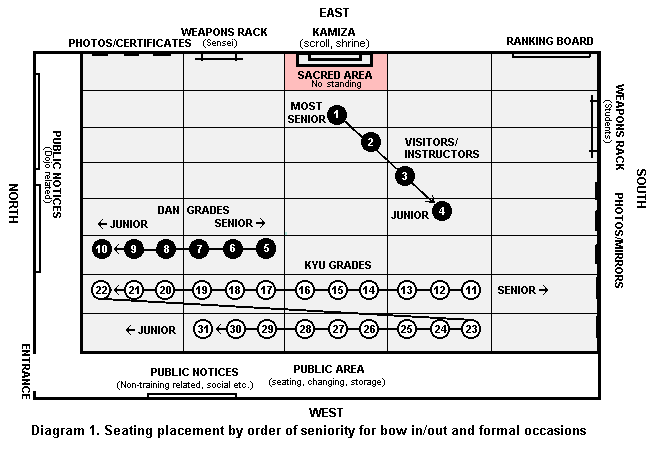
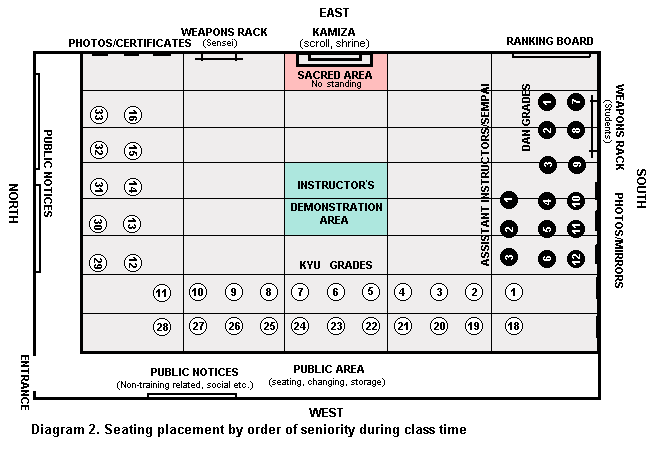
Diagrams 1 and 2 show the seating arrangements in the dojo for two different settings, one formal and the other less formal. These rules are derived largely from Japanese custom which has been developed over centuries of influence from both Buddhist (Zen), but predominantly Shinto ritualistic practices. Most Japanese martial arts align themselves philosophically and/or spiritually to one of these religions, and this is why such ritual is found in the dojo.
In diagram 1, the arrangement is for the formal bow-in at the beginning of class, and the bow-out at the end of class. It also applies for any special ceremonies or events that may take place, such as visits by an important person, a religious ceremony, or the beginning and end of a public demonstration.
In diagram 2, the arrangement is for activities that occur after a formal bow-in, such as general training, seminars, and gradings.
General notes:
Depending upon the seniority of the person who is placed in position 1, the distance of that person from the Kamiza varies. Only the most important and high level of individuals would be seated directly in front of the Kamiza at such close distance (1 tatami). O-Sensei would sit at this position during prayer. Shinto priests who preside over religious ceremonies would sit here, or perhaps further back, as would government or royal officials. A shihan would sit directly in front of the Kamiza, but several tatami distant. The status of the most senior person present on the occasion would determine the distance of position 1 from the Kamiza, (as closeness to the Kamiza implies closeness to the Gods) and all subsequent positions below that senior person would follow the order of seating as per the diagram.
Positions 1-4 would be generally senior representatives of different organisations, placed within order of their status in outside society. The Dojo Cho (head of the dojo), if lower in rank or status than visitors, would place themselves at position 4, or the lowest of the diagonal arrangement. This shows both deference to the esteemed visitors, and superiority over the members of the dojo present on the occasion. It is possible that the Dojo Cho would place themselves at position 4 even if they were of higher social standing than some of the visitors, to show deference to the visitors.
If the ceremony were to be held for and by members of the dojo only, then positions 2-4 would not be occupied by the assistant instructors, but begin at position 5, unless the assistant instructor had a highly active role in the proceedings of that day, where they would then take position 2 to the Dojo Cho.
When taking a seat, the most junior of the dan grades would take a seat first, at position 11, and offer higher grades to sit to their right, showing deference. Subsequent seated dan grades would offer the position at their right to the next highest ranking dan grade, thus, the positions at 5-11 would fill up in a left to right manner.
The most senior of the Kyu grades would set the seating arrangement for the rest of the student body by seating themselves first at such a position that would accommodate the correct lining up of the rest of the student body. The kyu graded ranks would endeavour to be seated before the last of the dan grades (position 5) would be seated. Positions 1-4 will usually be filled last, with position 1 being the last to sit, and the first to lead the ceremony.
If members are called forward separate from the main groupings, then the juniors take up positions to the left of the most senior student called forward. The senior of the students called forward has to make the decision where to best position themselves, being mindful of the subsequent positioning by the junior students to follow.
General Notes:
The position of the members of the dojo in this less formal setting, that of training or grading is primarily geared towards leaving the greatest amount of free space in the middle of the training area, to allow for grading and demonstration. When training commences, students pair together and train wherever available, but once training has ceased, students return to this arrangement as closely as possible for the demonstration by the instructor.
Of the kyu grade ranks, positions 1-11 and 18-28 would be filled first, before the group began filling positions 12-16 and 29-33. For a smaller group, there would only be need of 2 ranks or more on the West wall. The ranks on the North wall would only be filled if the class was too large to fit in line along the West wall alone. Should ranks along the North wall be required, then the front rank on both walls takes seniority over the second and subsequent ranks.
Positions 28 and 29 and 33 (the junior corners) would normally be occupied not necessarily by the lowest of ranking students, but by ones who had to exit and/or re-enter the mat area regularly or intermittently, despite rank, for non-training purposes, such as dealing with matters off-mat. If a dan grade is required to leave and/or re-enter the mat area on a regular or intermittent basis, then they would occupy position 12 (junior corner), despite rank.
The instructors demonstration area is directly in front of the Kamiza out of respect, and in the centre of the room to allow all participants equal opportunity to view the demonstrations.
At any time when a small group of students is separated from the main body and required to sit, the juniors would sit to the left of the senior. Grading partners, despite rank, sit to the left of the student being graded, because the situation requires that student to be in the position of importance.
Of course, these rules may vary slightly from dojo to dojo, and from organisation to organisation, but hopefully readers can get the general idea of where they can sit next time they walk onto the tatami.