記録 Archive
The goals of Aikido as a martial art
O-Sensei was often heard to say “Aikido is Budo”, ie. Aikido is a Martial Art, which means that we are training for the sake of learning a Martial Art. All too often we lose this focus, and end up learning techniques for the sake of training.
So when we practice Aikido, we must bear in mind the techniques we are learning must be practical and effective, and that training must be realistic and valuable. This way we can develop the ability to defend ourselves.
However, O-Sensei also described Aikido as being the vehicle with which we can achieve enlightenment. How do we reconcile these two goals? If we examine O-Sensei’s legacy of Aikido, we can see that Martial ability is foundation of Aikido upon which our spiritual development is based. So we must learn the Martial techniques first, then use those abilities to foster the spiritual principles that O-Sensei would later talk and write about in the doka, and speeches.
In an attempt to place the techniques and principles of Aikido into a realistic perspective, I have devised a flowchart which demonstrates the Aikido self-defence method against attack, as an aid to developing this ability.
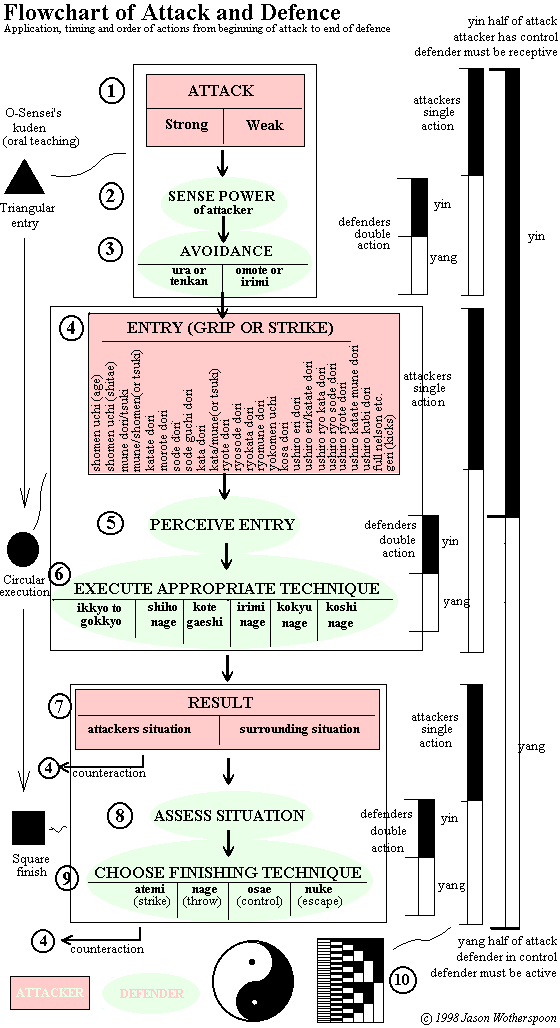
NOTES: This chart applies to hand techniques only. Some combinations of techniques may not be possible due to certain physical impracticalities. Each black arrow represents a change from one step to another. This chart is created by the author as a guide for those interested. It is not necessarily endorsed by the Takemusu Aiki Association.
1. Attack. The moment that attack is initiated should be evident from body language, and contraction of throat muscles a sharp in-breath. This step is the “attackers” side of the encounter.
2. Sense Power of Attack. An immediate unconscious response to Step, While maintaining a relaxed and passive attitude, breathe in and sense or feel the power and intention of the attacker. This is the “yin” half of the defenders step which is the response to the attack at Step 1.
3. Avoidance. An immediate conscious response to Step 2, your sensing should determine the strength of the attack, and your avoidance, should be entering to meet or turning away to deflect accordingly. This is the “yang"half of the defenders step.
4. Entry. Entry is the type of attack, a strike or a grab.
5. Perceive Entry. An immediate unconscious response to the attackers entry. As in step 2, you must be relaxed, passive and open to receive the focus of the attackers intention, the yin half of the defenders step. This point is the end of the inbreath, and outbreath begins.
6. Execution of Appropriate Technique. Choice of technique is determined purely by the attackers entry at step 5. This is the yang half of the defenders step; there should be no conscious decision as to what technique to perform, but there should be a conscious, motivational feeling of action to overcome in order to survive.
7. Resulting Situation. The execution of your technique leaves a resulting situation, both in the immediacy of your attackers body position and the surroundings in which you both stand.
8. Assess Situation. By being passive, open and receptive, you perceive the resulting situation, the level of threat from both the attacker and the surroundings. This is the yin half of the defenders step for this point.
9. Choose Finishing Technique according to your perception of the resulting situation. This is the yang half of the defenders step. At this point you exercise your moral will in order to neutralise the attack yet remain guilt free in your actions. Your moral will is a personal attitude that you have decided upon previous to the attack.
The first half of the flowchart, from Step 1 - 5 describes the “yin” or passive, receptive feeling on the defenders side, which is connected with the inbreath, represented on the chart by the solid black line down the right side.
The second half of the flowchart, from Step 6 - 9, describes the active or “yang” role taken by the defender, which is connected with the outbreath, and is represented by the white bar down the side of the page.
10 This small diagram illustrates the idea of cycles occurring within cycles, and relates to the black and white bars down the right side of the flowchart. In nature, as time passes, energies rise and fall in cyclic patterns. By recognising that these cycles occur within other cycles, we can realise the interconnectedness of events, actions and consequences etc. The yin-yang symbol maybe related to these
[The original page ends here, mid-sentence.]