記録 Archive
Caring for your jo
A well fashioned Jo made from a piece of well selected timber is much more than just a stick of wood, it is one of the most practical and devastating of self defence weapons, upon which you may come to rely upon with your life. With proper care and attention, your Jo should be able to stay free from warping or splitting, and bear years of use which may involve bending, torsioning, heavy impact, changes in climatic and atmospheric conditions, and periods of long term storage. Without proper care, your Jo can easily warp and quite possibly split under heavy impact. Considering that it’s possible to pay well over $100 for a good Japanese Jo, if one expects many years of life from it, treating it with a reasonable amount of care is only common sense.
The three main problems confronting Jo users is warping, splitting and splintering. Warping is caused by two things; long term lateral pressure from improper storage; and warping of the wood as it adjusts to changes in either moisture content of the atmosphere or the wood itself. Splitting is usually caused by excessive sudden lateral pressure, and splintering is caused by excessive impact, or impact greater than the Jo can bear.
Warping
Being rather partial to the staff as a weapon, I can say there is nothing more depressing than praciticing techniques with a bent Jo. The balance feels strange, your accuracy is poor, and the stick just moves uncomfortably in your hands. People like a straight Jo. One of the first things they do when picking one up for the first time is to sight down the length and see how straight it is. With a straight Jo, not only does it feel right as you swing it around, it is easier to be precise in your movement, and power can be correctly and fully applied to the target, particularly with the thrusting techniques.
When I buy a new Jo I always store it by hanging it on a hook (see fig. 1). This is the safest method of storage, as gravity exerts pressure along the length of the Jo rather than lateral to it. Never leave the Jo leaning against a vertical surface, eg. wall, and if you have to leave it on the ground, ensure that the surface is perfectly flat. New Jo come from a different atmospheric condition to that of your place of storage, so the Jo will naturally readjust to the ambient moisture content of the new environment. If there is any lateral pressure to the Joduring this adjustment period, the wood will naturally bend.
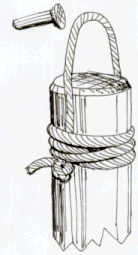
Figure 1. The loop can be made by holding a single piece of string over
the end to form the loop, then wrapping it around itself to hold it tight.
Knot the loose end. Hang on a picture hook or a nail protruding from a wall.
Seasonal changes in the weather can also cause the Jo to warp: the humidity of the atmosphere varies dramatically between summer and winter, and the Jo naturally absorbs moisture from the atmosphere if it is too dry, or evaporates moisture by drying out, if it is too moist. Again, poor storage can cause the Jo to bend. I have found that my 10 year old Japanese white oak Jo from Tsukuba will go through occasional periods of bending slightly, due, I think to storing it incorrectly for short periods…the Jo will develop a bit of a bend, but after hanging it again, or being careful where I place it outside of use, the bend goes away.
A third factor in warping is the wood itself. Most wood these days has been improperly seasoned, so when sold it is invariably still high in moisture content. Seasoning requires years of storage of the timber after felling and milling, usually in a timber yard, but these days in our fast paced society, the seasoning period is usually cut short, or done quickly in kilns in order to get the timber on the market. The result of this is that timber in its end use is still seasoning itself, and thus will bend if it receives any lateral pressure.
In traditional English bow making, the wood was once immersed in a stream for a year before it was dried then fashioned into a bow. This is because newly felled, unseasoned timber is still high in natural acids and saps which have complex mineral and chemical compositions from the growing process. Soaking in flowing water for a year had the effect of filtering out the sap and replacing it with water, which could be totally removed later upon drying. The wood was then treated with oils to strengthen and preserve it for the uses required by archery.
As a newly felled unseasoned timber dries out, the expulsion of the sap and mineralised fluids causes the wood to lose its flexibility, and the shape the wood is in once these fluids have left is the shape that the timber will retain. This type of warp is usually much more permanent and difficult to reverse. If the Jo is made before the timber has properly seasoned, then the shape it warps into will be very difficult to remove, and may in fact render the weapon useless. If the Jo has been made after proper seasoning of the timber, then the newly fashioned shape will have much less tendency to subsequently change from straight and true. This is the major reason why the Jo should be hung upon purchase, because unless you are an expert in working with timber, you have no way of knowing whether the wood has been seasoned properly or not.
So, after buying a new Jo, it is very important to guard against possible warp by either hanging it vertically on a hook or nail, or laying flat on a perfectly flat, straight and true surface.
Splitting
Splitting is caused by excessive sudden lateral pressure, which means the wood cannot flex enough to absorb movement perpendicular to the length of the grain. When a Jo is about to split, the sound which the weapon makes as it strikes another begins to change, becoming slightly dull. There are a number of factors that determine the threshold at which a Jo will split, such as type of wood, condition of the wood, and the techniques used in Jo training. Choosing the right type of wood for a Jo is the first thing that should be considered in preventing splitting. See here for a discussion on appropriate woods for Jo.
New Jo also have slightly more tendency to split than those that have been used in training for more than a few years. Older Jo have absorbed the sweat and natural oils from one’s palms, and this has a definite effect upon the physical properties of the wood. Just as one has to oil and “knock in” a cricket bat before use (otherwise the willow, even of a top brand such as Gray and Nichols etc, will split with heavy striking), so too the Jo must be “knocked in” before one practices heavy striking in kumi-jo or ken-tai-jo exercises. My Tsukuba Jo got darker, heavier and more flexible over the years, and can take much greater hitting now than it could when new, because the sweat and oils of the skin have been absorbed into the wood, which has no doubt protected and preserved the wood. In fact, on a very humid day, say, before a thunderstorm, it actually “sweats” and on occasion has to be wiped with a towel else it slips out of my grip. In a way, the wood of a Jo that has properly “matured” with use seems to regain some of the desirable properties of newly felled timber, ie. flexibility and resilience, while retaining the desirable properties of seasoning and drying, ie. strengthening, solidifying, and maintaining shape over time.
Splintering
Another problem we have with Jo is the tendency for the wood to splinter under heavy impact. One of the virtues of white oak (and some other woods) is that due to the nature of the grain, they tend to crush inwards under heavy impact. Many woods, if they do not split outright, will dent from the impact, but at the outsides of the impact area, their fibres tend to break and lift. This is undesirable from a users point of view, as splintering will injure your hands. The ideal quality is that the wood maintains its grain structure, but crushes upon impact. New Jo, where the wood is fresh from the kiln and the woodworker, can be somewhat more brittle than an old Jo that has had much use. Once again, the sweat and natural oils from the hands that get absorbed into the wood from training, moisten and lubricate the fibres of the wood, making them more durable, flexible, and denser. This improves the overall impact resistance of the wood, and retains the integrity of the fibres in the grain of the wood.
Further to that, the impact of striking wooden weapons together with the Jo tends to compress the fibres of the grain, and this also conditions the wood in such a way that it becomes denser, and more resistant to further impact.
In a recent striking test I performed for two potential new woods for making Jo using my Tsukuba Oak Jo, I hit the weapons together forcefully using repeated yokomen-uchi strikes to the point cracking and splitting. Both the Australian woods, Tasmanian Oak and Spotted Gum crushed well (the Oak considerably more so than the Gum) before splitting, but my Tsukuba Jo did not suffer even a dent…at worst, the surface sheen merely got dulled slightly. A new Jo, even from Tsukuba, would have exhibited some measure of denting (crushing) under similar conditions.
Some people like to treat their Jo with a light oil such as linseed, and this will protect the wood (this is the oil used for cricket bats), however, I wouldn’t recommend it, because during intense training on a hot or humid day, the oil will tend to leach out of the wood, and this will cause the Jo to become very slippery, which can cause problems. Even with a Jo that hasn’t been oiled, a hot humid day where one sweats more than usual will cause the Jo to become slippery.
So it is recommended that your new Jo not be immediately used for heavy striking. Give it 6 months or more of regular, extended solo use, such as with suburi, kata, and awase training, and build up contact slowly over a period of time. This suggestion is coincidentally entirely in keeping with the development of your Jo technique as you progress from beginner to more advanced - start with suburi, then kata, then awase before kumi. Start your Jo training with a new Jo, and your Jo will grow with you. As you become familiar with your weapons, you will develop an intuitive feel for the wood and the way it responds to impact with other weapons, and you should be able to estimate the physical limits of the wood.
Of course, over time, wood degenerates, and it is said that even Japanese White Oak has a limited lifespan. How long that lifespan is depends upon how well the Jo is cared for during the initial years of use.
Technique
Of lesser importance, though no doubt of equal interest, is the nature of the techniques themselves when used in striking Jo together other weapons. Particularly for Iwama style Aiki-Jo, blocking or parrying involves not so much a direct striking action (see Fig. 2) as it does a deflective strikingaction (see Fig 3).
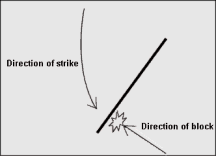
Figure 2. The direction of blocking or parrying force against a strike with theJoin this example
is more direct, and bears the full weight of impact and load.
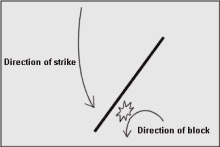
Figure 3. With a circular or deflective blocking action against a strike, much of the force of the
strike is deflected from theJothat blocks and carried forward in the movement of
the attackersJo*.*
If your technique is not correct and you block directly, the force of the attacking Jo will be transferred directly to your blocking Jo, and this will contribute to potential overstressing of the wood. With a more refined or developed technique, you should be able to effectively block a powerful strike without overstressing your Jo, because rather than meeting the attacking force directly, you deflect much of the attacking force forward.
Correctly performing Jo techniques can contribute greatly to preserving the integrity of the weapon, so care is needed in this repect as well.
Good luck!
Jason Wotherspoon