記録 Archive
Attaining mastery
Introduction
In becoming skilled in any given art, 3 types of knowledge (Declarative, Procedural and Conditional) is encountered in 5 levels (Pre-structural, Uni-structural, Multi-structural, Relational, and Meta-Relational). Throughout this process, these types of knowledge change from what is perceived by the student to be theoretical, to applied, in order for the student to become a practitioner.
Skill is a high level of both competence and expertise. Competence is the level of ability, or dexterity in performing actions, for example; how well one can do something. Expertise is the level of technical complexity one is able to perform, for example; how difficult the task that one performs.
Attaining mastery in any given art involves the transcending of skill, where one uses themselves to demonstrate their art, to becoming a master, where one uses the art itself to express themselves. Thus true mastery comes not only from being able to perform highly complex tasks very well, but embodying this skill in daily life and using it as a method of self-transformation.
A. Types of Knowledge
1. Declarative knowledge (“what”)
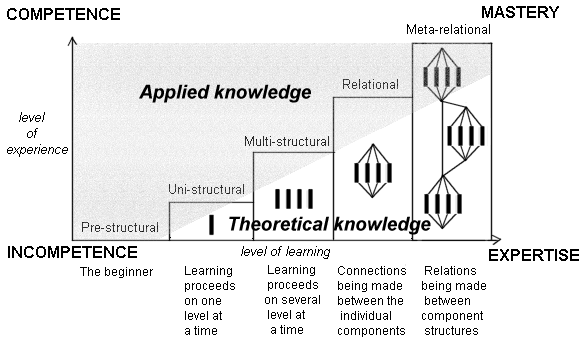
At first the student is exposed to information in the form of content; details, facts, figures and units of information that require being stored in the memory. This can be referred to the “what”, and is very much like learning the names of tools. Within the context of learning a martial art, it is the stage where one learns the names, details and functions of techniques, the parts of the body involved in performing the technique, as well as the names and function of the items within the dojo. This exposure happens firstly on a simple level, where one learns this information in a single, linear pattern, or thread, and can be called “Uni-structural” learning. (see Figure 1 below.) Then other information, seemingly unrelated to the first, is learned, each also in single linear patterns. After a certain period, the student may begin to realise that items of knowledge they have gained in this linear fashion can be grouped according to categories of similarity and/or relationships. Facts about new items, as well new facts about familiar items are learned concurrently, so one is learning a number of things at the same time, though it is still in a threaded form, where several threads develop concurrently. This can be called “Multi-structural” learning.
2. Procedural knowledge (“how”)
When the student begins to make connections between the individual units of detail, and learn ways of putting this content knowledge to use, they are ready to learn the “how”, or the next level in development, procedural knowledge. This type of learning is different from the memorising of facts, rather it makes the jump in understanding of how to use these facts in a useful way, very much like learning how to use the tools, now that their names and nature have been learned. It is learning the procedures that utilise the content. In the context of learning a martial art, this stage is where one learns how to perform the techniques in different situations.
3. Conditional Knowledge (“why”)
After the student has learned all the details, and all the procedures, ie. what to do, and how to do it, only then can one be in a position to learn the “why” (and “when”) to use them. This form of knowledge is learning to know when and why one applies the knowledge they have already learned, and this form of learning takes on a new level as it is not so much learning anything new but rather taking the time and making the connections between all the components and separate items of knowledge already attained, in order to form a new body of knowledge that governs the conditional use of the knowledge. It is very much like taking the tools and one’s know-how, and actually building something. In the context of learning a martial art, by this stage one already knows the techniques and how to perform them, and is now learning how to make the decisions as to which technique to perform in any given situation. When one can make the “Meta-relational” connections between all the components of their knowledge, then one is able to achieve mastery in their given art.
Figure 1. Patterns of Learning
Five steps in gaining mastery from incompetence to mastery (After Biggs & Collins 1982)
B. Patterns of Learning
1- 2. Pre-structural and uni-structural learning
The student, when they first begin their learning, is without any knowledge of the art itself, and so can be called “Pre-structural” Upon encountering knowledge, it is absorbed in a continual stream, as their mind is open and they take in new knowledge. This stream is “Uni-structural”, as it is simply a series of facts, or content, following one after the other and being deposited into the memory. In the context of learning a martial art, this stage can be related to learning a single technique.
3. Multi-structural learning
As the student becomes more familiar with the content and with the method of encountering such knowledge, this uni-structural pattern grows and the student becomes ready for new types of information. At his point, the single thread of knowledge grows to the point where the student is able to create sub-categories of related information within the thread of uni-structural information. So the student then creates new streams of knowledge and adds to them, thus creating a subdivision with several threads operating concurrently. When extra information is encountered, it is now able to be broken down into these categories established by the student, and threaded, uni-laterally, still in a linear pattern. This type of learning is thus said to be “Multi-structural”. In the context of learning a martial art, this stage can be related to learning multiple techniques, but also can be related to the learning of new methods of training.
4. Relational learning
Once the student has a number of streams of knowledge, each growing at their own rates, the student may realise they have a number of various components of knowledge, or structures within their field of understanding, and will begin to wonder how these streams relate to each other. At this stage the nature of the teaching can be changed again. While teaching can continue on a “multi-structural” path, a new form of teaching can now include making the connections between the individual streams of knowledge, forming some semblance of connective structure within the students mind. Structuring knowledge is important in one respect, as it allows the student to create a map of the knowledge they possess, which facilitates an easier placement of new knowledge encountered. It also deepens the understanding of the knowledge the student already possesses, and can improve speed in learning because by making their own connections between individual components of knowledge, the student can advance on their own to a certain extent without the need for new information, and by having a structure in place, new information can be quickly processed and placed within the present structure without upsetting the body of knowledge already present. In the context of learning a martial art, at this stage one may begin to see similarities between various techniques, and see connections between various principles related to individual techniques and individual concepts, thus enabling the student to gain some feeling of consistency and coherence within their art.
5. Meta-relational learning
After the student has begun defining their body of knowledge as being a collection of components that consist of structured units of knowledge that have relational ties together, the student should be able to see how these structures within the art reflect and relate to systems and structures in the real world. By making this jump in understanding, which begins to relate their knowledge to the real world through the concept of relationships between structures within structures, the results of long years of training within the art can manifest and influence the students’ daily activity in the real world. This is the true value of learning any art, as the high theoretical principles within the confines of a learning environment can now be put to use and be of benefit to the student. At this stage, the student is able to now draw upon all the threads, items and structures of their body of knowledge, and put it to use. They become “the practitioner” rather than “the student”.
C. Application of knowledge
1. Theoretical Knowledge
At first, the knowledge gained remains in the mental world of the student as a body of information that has been learned. The knowledge is theoretical, in that it has largely been an intellectual activity. When one enters the learning environment, a mental door is opened, and one enters the room of that knowledge. After the learning session has been completed, one leaves that mental room of knowledge, and enters other rooms of knowledge, ones that deal with other areas of one’s life. What has happened when one leaves that room is that the knowledge previously learned is stored and forgotten, only to be remembered and encountered when one consciously approaches that mental room again.
2. Applied Knowledge
At some point, one must begin to carry the knowledge from that mental room to the outside, to the larger room, the one which represents the body of knowledge one associates with the outside world. This means that the knowledge one has gained within the learning environment is now taken beyond the learning environment, and put into practice in the real world environment. Techniques, skills and principles thus begin to serve some useful function in the students life. As the student applies this theoretical knowledge to the outside world by putting it into practice, further learning is gained by observing and noting how this theoretical knowledge relates and responds to the outside world, and how the outside world responds to it. This form of learning is experiential learning, and the knowledge is practical and useful.
So theoretical knowledge must be put into practice before it can become real, or pragmatic knowledge. When theoretical knowledge becomes applied to the real world, it not only becomes useful, but the student begins to realise the true value of the knowledge theyhave been learning.
D. Mastery
Mastery is thus more than just competently performing the complex tasks that the body of knowledge requires. There needs to be a number of step by step processes followed and completed, before mastery is attained. Expertise is gained through extended theoretical learning. Competency is gained through applying this theoretical knowledge by putting it to use. By gaining a high level of expertise, and performing with a high degree of competence, one becomes highly skilled at one’s art. At this level, one’s art can be called “jutsu”, or method, as in “Bujutsu” - it is a skill that one “does”. To become a master of the art, a certain transformation within the practitioner needs to take place, in order to go beyond the level of simple skill.
Mastery is where the practitioner is able to apprehend the world through the eyes of their art, and by performing their art, is able to produce works of great beauty and value to the outside world. To do this, one must allow the principles of the art to guide them in their own development as a human being. At this level, one’s art becomes one’s way of life, and can be called “do”, as in “Budo” - where one IS the art.
However, mastery has two phases.
1. The Art through the Person
The first is where the practitioner of the art, while performing the complex tasks competently, is restrained by the art itself. The art is manifesting itself through the person. This is rather like the practitioner being an example of the art, using their body and actions to manifest the art itself. At this stage the level of ability of the practitioner should more correctly be still termed “skill”.
2. The Person through the Art
The second phase is where the practitioner, while perfoming the complex tasks competently, is not restrained by the art itself, rather they manifest their own personality and creativity through use of the art, or rather, the person is manifesting themselves through the art. This is the realm of true mastery, where the character of the practitioner flows through their skill, and adds to the techniques of the art, and is called “embodying the art”. Furthermore, by living one’s life as a model embodying this art, the techniques and principles of the art itself effect a physical and mental transformation within the artist.
3. Final Attainment
The learning individual goes through a series of transformations over their educational career, due not only to the stages in learning discussed above, but also to the nature of their own body, in a physical and mental sense. The steps in our learning process are very closely linked with the physical and mental stages of our psycho-physiological development. As our body grows and ages, it goes through its own series of hormonal transformations, which affect the way in which we learn. The three stages of physiological development, growth, prime, and decline are also the stages at which our learning and use of knowledge is best applied.
a) Body
During the first 20-25 years of one’s life not only does the body grow from infancy to its prime, but the mind tends to acquire knowledge of a declarative nature, on a theoretical level. During this time people are concerned with their body. Learning an art helps develop and temper one’s physique, so the first stage of development could be called “Body”.
b) Mind
From the age of the early 20’s, one enters their prime, and begins to apply their learning by involving in work, where one gains procedural and conditional knowledge on the applied level. Towards the end of one’s working life, by the end of one’s prime, one has gained much experience, and reached a great level of skill. During this time one has used their body’s capabilities to carry out the tasks of life, and has been required to use their mental abilities to apply their knowledge to work. Towards the end of one’s prime, one becomes more concerned with intellectual pursuits, and one seeks to look for philosophical guidance from the art they are learning. This stage of development could be called “Mind”
c) Spirit
After retirement, perhaps around the age of 60, one is beginning to pass their prime, and the unfortunate decline in one’s physical and mental capabilities begins. One has already reached a high level of skill in their art, and as the body fails, the physical dimensions of the art begin to retain less importance than do the philosophical and spiritual dimensions of the art. As one begins to see the world through the eyes of their art, the art flows through them and its principles begin to take on a deeper meaning, and as the spectre of one’s death becomes more visible, one seeks to find spiritual meaning within the art. This period is where the art transforms the body and mind of the practitioner, to the point where one’s ability has transcended the physical nature of the art. This stage of development could be called “spirit”.
d) Attaining Mastery
After the gaining of knowledge in one’s youth, then the gaining of experience during one’s prime, one reaches the final stage in educational development; mastery. Hindsight allows one to apply their wisdom to their skill, which leads one to become master of their art. The ultimate attainment is mastery not of others, but the self.